


When Parliament Speaks for Those Silenced: Safeguarding Afghan Girls’ Right to Education
- PARLIAMENT NEWS

- Jan 21
- 4 min read
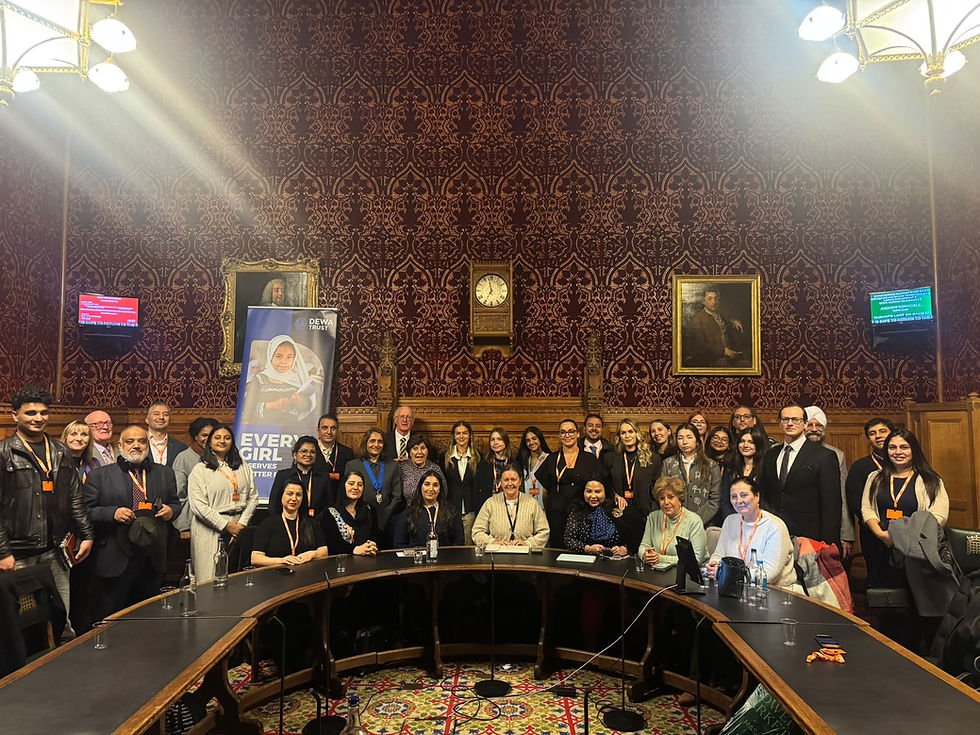
On Tuesday, 20 January, a parliamentary visit at the Palace of Westminster brought together policymakers, advocates, and civil society leaders for a moment of rare moral clarity. Hosted by the All-Party Parliamentary Group on Freedom of Religion or Belief (APPG FoRB), in collaboration with the Dewa Trust Foundation, the gathering focused on the ongoing crisis facing Afghan girls’ access to education—now in its fourth year.
In the heart of British democracy, the conversation was neither abstract nor diplomatic. It was urgent, human, and deeply grounded in safeguarding.


Setting the Moral Framework
The session was preceded by remarks from Julie Jones, Director of the APPG FoRB. With a background that includes service as a trustee of the Interfaith Network UK, interfaith representative for Wales, and Vice-Chair of the Interfaith Council of Wales, her contribution reflected years of experience in building understanding across belief systems and communities. She framed the discussion as one where freedom of belief, gender equality, and education are inseparable—and where silence is not neutrality.

Education as Safeguarding, Not Privilege
Speaking as Chairwoman of the UK Parliamentary Society for Arts, Fashion and Sports, Rebeca Riofrio delivered a powerful address titled “Awareness and Safeguarding for Afghan Girls’ Education.” Her speech cut through policy language and statistics, grounding the crisis in lived reality.
She spoke of the impossibility of fully grasping, from a place of privilege like Parliament, what it means for a young girl to be forbidden from learning at all. While many of us once took school for granted—some even wishing to avoid it—millions of Afghan girls are denied not only education, but the very notion of a future.
Drawing on her own journey of arriving in the United Kingdom as a teenager during a period of intense immigration debate, she described education as the force that transformed vulnerability into contribution—offering dignity, stability, and agency.
“Education transforms lives—completely and irreversibly,” she stated, emphasising that learning is not only about knowledge, but about dialogue, shared understanding, and the possibility of change.
Her intervention placed the Afghan crisis in stark relief. Afghanistan remains the only country in the world where girls are banned from secondary and higher education. Yet this ban, she noted, stands in direct opposition to the will of the Afghan people. A nationwide survey by UN Women shows that 92 per cent of Afghans support girls’ right to education—across genders, regions, and socioeconomic backgrounds.
“This is not about religion,” she made clear. “It is about extremism imposed against the will of the people.”
She outlined the safeguarding consequences with precision: rising early marriage, deteriorating mental health, enforced isolation, and the systematic erosion of women’s agency. Nearly three-quarters of Afghan women now describe their mental health as bad or very bad. This, she concluded, is not protection—it is containment.

A Royal Voice on Power and Responsibility
The discussion was further enriched by the intervention of HRH Princess Katarina of Serbia, cousin of King Charles III. Speaking with historical perspective and humanitarian insight, she reflected on the repeated tragedies that unfold when governments abuse power and strip populations—particularly women and girls—of their rights.
Her words served as a sober reminder that the denial of education is not an isolated act, but part of a broader pattern of governance failure, where unchecked authority leads to generational harm. The safeguarding of girls, she stressed, must be understood as a measure of a society’s moral health.


From Lived Experience to Lifeline
At the heart of the meeting was the testimony of Dewa Khan, Founder of the Dewa Trust Foundation. An orphan who grew up in Afghanistan, she spoke of learning early what restriction means—restricted education, restricted freedom, restricted opportunity—simply because of gender.
Later in life, as a three-time cancer survivor, she faced mortality repeatedly. Each time, she chose to fight, driven by the belief that her life still carried responsibility.
“I stand here today because, at critical moments, someone believed I was worth investing in,” she said. “Millions of girls today are not being given that chance.”
From that lived truth, Dewa Trust was born. The charity works across education access, humanitarian relief, and health and dignity support, partnering with trusted local networks to deliver culturally sensitive solutions. With traditional schooling no longer a reliable option for many girls, she outlined the Trust’s vision for a secure education app—designed to allow girls to access curriculum-based learning remotely, discreetly, and safely, even when schools are closed.
“For these girls,” she explained, “technology is not a convenience—it is the only scalable, realistic pathway to education.”
Yet the challenge remains funding. Each month, girls ask when they can begin learning—and too often, the answer is “not yet.”
“This is not charity alone,” she concluded. “It is prevention, stability, and investment in human potential.”

Parliamentary Affirmation and Collective Presence
The meeting closed with remarks from Jim Shannon, Chair of the APPG FoRB. His words offered affirmation and encouragement, reinforcing Parliament’s responsibility to continue advocating for freedom of belief, education, and safeguarding for Afghan girls. He commended the courage of the speakers and the necessity of sustained political pressure and partnership.


Among the attendees were members and friends of the Parliamentary Society and wider civil society, including Rebecca Ferdinando, Katerina Astrella, Elvijs Plugis, Lara Accison, Fifi Anicah, and Audronė Gedrimaite—each present in solidarity with Afghan girls whose voices have been forcibly silenced.


When Parliament Must Not Look Away
The message that resonated through Westminster was unmistakable: education is not a cultural debate, nor a political concession. It is a safeguarding imperative.
Every minute of inaction narrows another girl’s future. And until Afghan girls are allowed back into classrooms—until their minds are protected alongside their bodies—Parliament, and the international community it represents, must not look away.
On that day, in the halls where laws are shaped and values affirmed, Afghan girls were not forgotten. Parliament listened—and spoke—for those who cannot.
For more information on APPG FoRB https://appgfreedomofreligionorbelief.org/


Comments