


The Future Walks the Runway: Westminster Fashion’s Class of 2026 Delivers a Powerful Vision of Tomorrow


There is something magical about a graduate fashion show.
Perhaps it is because it reminds us of beginnings.
I have attended graduate shows for many years. Long before I worked in media, television, publishing and international events, I was a student myself, sitting quietly in the audience, watching nervous young designers present their dreams to the world for the very first time. Even then, I understood that these shows were about far more than clothing. They were about courage. They were about possibility.


That feeling has never left me.
Every year I look forward to attending the graduate collections presented by London's leading fashion institutions. There is an honesty at these shows that is often difficult to find elsewhere. The students are not following trends. They are creating them. They are not selling a product. They are introducing a point of view.
The University of Westminster's BA (Hons) Fashion Design Show 2026 was a perfect example of this.
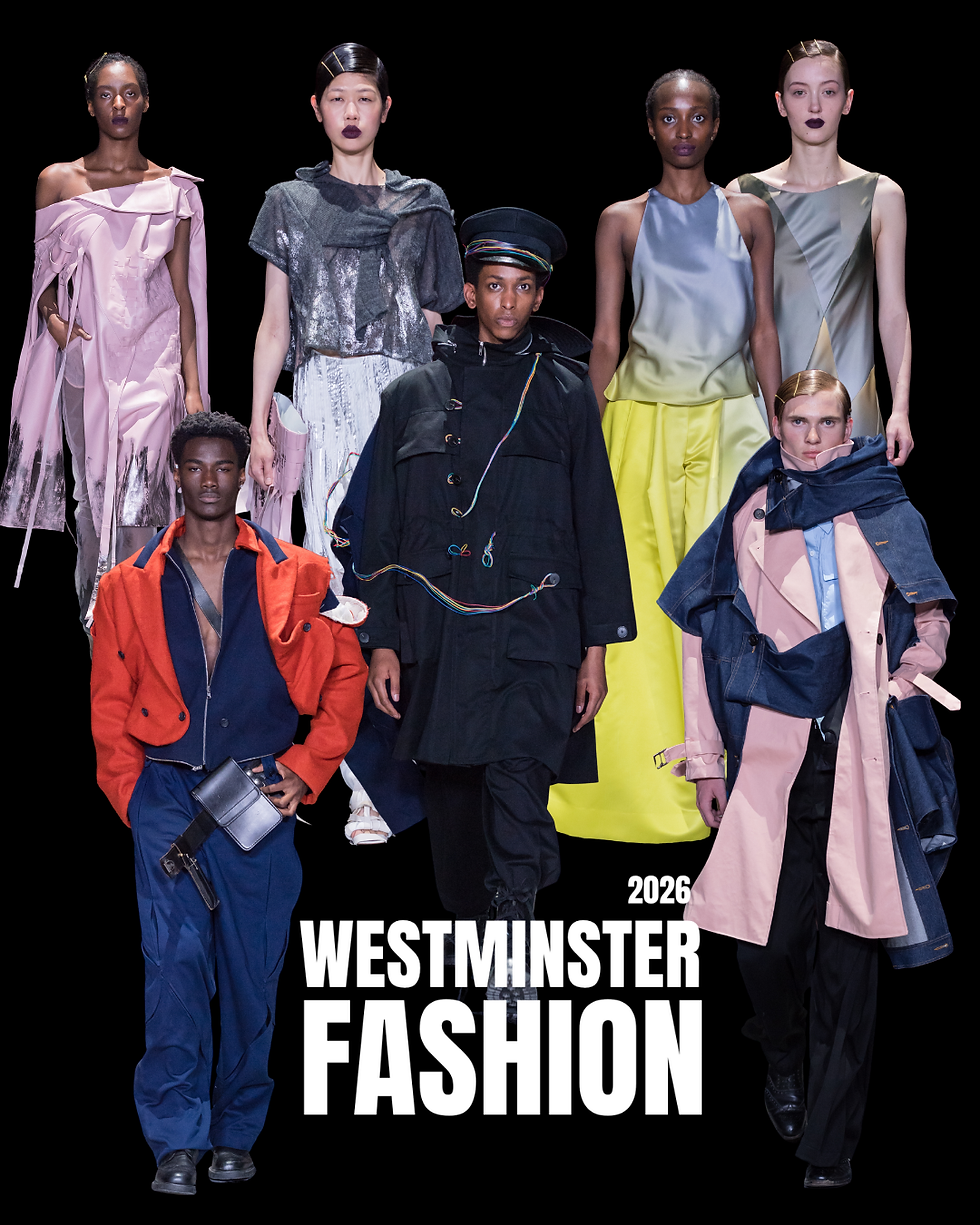

The collections presented by this year's graduates were not driven by trends or commercial formulas. They were driven by stories. Stories of family, heritage, memory, identity, migration, belonging, sustainability and self-discovery. In an industry often criticised for chasing the next new thing, these young designers demonstrated something far more valuable: authenticity.
What struck me most was the remarkable diversity of perspectives.
Qihui Ye opened a conversation around modern masculinity through Ensembles, a collection that balanced precision with elegance, whilst Aliyah Dankwah drew upon her Ghanaian heritage in In Tension, creating sculptural silhouettes that explored structure and fluidity. Leqi Zeng's In Between Gestures found beauty in the imperfect and overlooked moments of everyday life, whilst Rachael Adegoke's Bridging Aso successfully united Nigerian cultural traditions with British tailoring in a thoughtful celebration of identity and craftsmanship.


Elsewhere, Alex Lyons transported the audience into a world inspired by Samurai discipline and ritual through Modern Ritual, whilst Georgia Tennant's beautifully considered The Entomologists demonstrated that sustainability and elegance can coexist effortlessly. Kane Tsz Lung's Vice City channelled the visual language of Hong Kong crime cinema, while Sumi Kim's exquisite Cut by Light transformed the movement of sunlight into fluid, contemporary womenswear.
Themes of memory and personal history appeared repeatedly throughout the evening. Tom Fee's ORDER Permits Freedom explored routine, structure and liberation through a deeply personal lens. En Zhi Khoo's Tailored Through Time reflected on identity across generations, while Florence Kelk Whall's playful Tour de Couleur revisited the romance of early cycling culture through a modern perspective. Chienjui Tseng's The Poetry of Spaces offered a poignant reflection on home, memory and belonging through remarkable textile experimentation.


Some collections found inspiration in the people and environments around them. Oliver Orr's Spirit Ditch celebrated the beauty found within everyday characters and city life, while Kun Luo's Remaining embraced imperfection and continuity through garments that carried the visible traces of time and wear. Haeun Stemple's Almost Belonging translated experiences of displacement and transition into layered menswear, and Nikyla Natividad's vibrant Mabuhay honoured her Filipino heritage through colour, craftsmanship and joyful storytelling.
The show continued to reveal extraordinary imagination. Olly Dye's Hunter explored notions of protection and confidence through dramatic silhouettes and intricate detailing. Olivia Grace Robinson's intriguingly titled I Saw the Innards of the Fruit Machine examined class, labour and identity through sophisticated menswear rooted in personal experience. Olucci Oko's Rhythms Beneath the Cloth celebrated Nigerian culture through movement, texture and colour, whilst Elise Cullen's So, You Think You're a Cowboy? challenged popular perceptions of Western mythology through a contemporary and sustainable lens.
The final collections brought the evening to a thoughtful conclusion. Jocelyn Andra's It Doesn't Fall Far From the Tree paid tribute to family, heritage and craftsmanship through beautifully executed garments inspired by her Indonesian roots. Xinyan Chen's Metropolitan Villagers explored intergenerational memory, migration and identity, offering a powerful reflection on the relationship between rural origins and modern life.
What made this show memorable was not only the quality of the garments. It was the intelligence behind them.
These young designers are entering an industry facing significant challenges. Sustainability is no longer optional. Consumers increasingly demand authenticity. Technology is reshaping creativity at extraordinary speed. Yet rather than being intimidated by these realities, Westminster's Class of 2026 appears ready to embrace them.
Their collections demonstrated technical skill, certainly. But they also revealed curiosity, empathy and an awareness of the wider world. Those qualities cannot be taught through pattern cutting or garment construction alone.
As I sat watching the final looks leave the runway, I found myself remembering my own student days. The uncertainty. The excitement. The belief that the future could be anything.
That same spirit filled the room.
Graduate shows are where careers begin. They are where new voices first find an audience. They are where the future of fashion quietly introduces itself before anyone knows its name.
The University of Westminster's Class of 2026 reminded us of that beautifully.
Some of these designers will go on to establish their own labels. Some will join major fashion houses. Some may redefine the industry altogether.
Whatever path they choose, one thing is already clear.
The future of fashion is in capab
Pictures provided by Thomas Fee / Westminster University



Lately, I was searching for a reliable download reel Instagram tool that works without installing any application. After trying a few different websites, this one worked surprisingly well for me and the process felt very simple.z