


The Art of the Invisible Rebuke: A King, A Speech, and the Weight of History

By Rebeca Riofrio

True diplomacy lies in revealing where one has erred, not with force, but with such grace and clarity that the lesson is welcomed—where history guides, elegance persuades, and truth rises far above tyranny. It is a rare mastery, found only in those schooled in grace, who can correct with wit, inspire with laughter, and leave their audience not diminished, but enlightened.
State visits are never simply ceremonial. They are protocols, yes—but protocols with consequence. Every movement is measured, every word negotiated long before it is spoken. And in April 2026, when King Charles III arrived in Washington the stage was more fragile than it had been in decades.

This was no ordinary visit. It came at a moment of visible strain in the so-called “special relationship”—a phrase that, increasingly, feels nostalgic rather than descriptive. The United Kingdom had refused to align itself with the United States in the escalating conflict with Iran, a decision that unsettled Washington and irritated President Donald Trump. His rhetoric in recent months—towards Prime Minister Keir Starmer, towards Europe, towards institutions long considered allies—had not softened the terrain.
There were even voices, within Parliament, suggesting the visit should not proceed. And yet, it did.
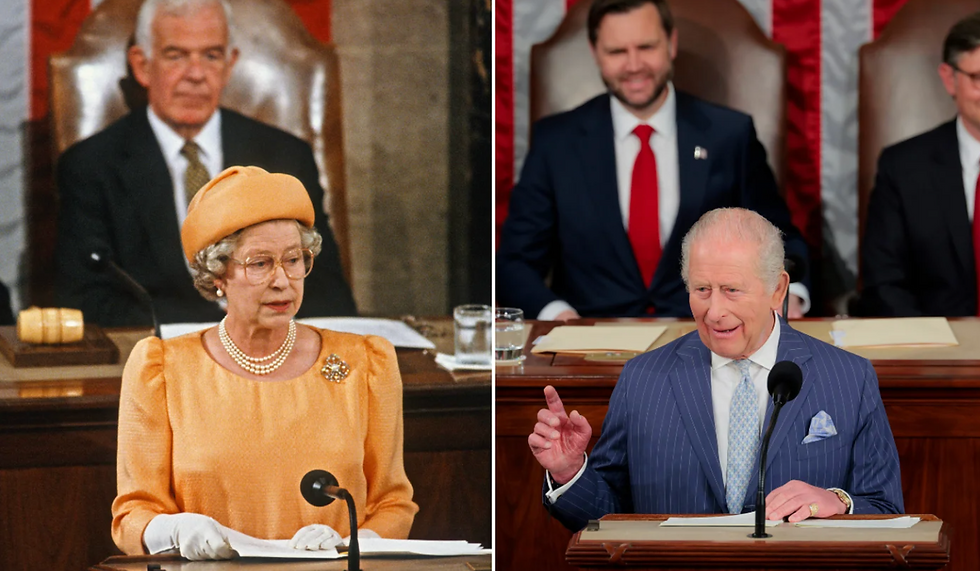
History framed the moment. The last time a British monarch addressed Congress was in 1991, when Queen Elizabeth II stood before a chamber shaped by post-Cold War unity and shared military purpose. That speech was grounded in visible alliance—joint action, common enemies, mutual clarity.
Charles arrived in a different world.
A world where alliances are questioned, where diplomacy competes with spectacle, where power is increasingly performed rather than exercised with discipline. Which is why this speech mattered!

Because it was never just a speech.
It was constructed—carefully, deliberately, and with remarkable precision. Those close to the process describe a meticulous collaboration between Buckingham Palace, Downing Street, and the Foreign Office. The King himself, deeply involved, is known to mark drafts by hand—red ink across printed pages, notes in the margins, entire passages reshaped. His private secretary, Sir Clive Alderton, alongside senior diplomats and communications advisers, would have ensured that every sentence served a purpose.
I am told—reliably—that even during the flight to Washington, the speech was still being refined. Final touches. Final calibrations. Because in diplomacy of this level, nothing is accidental.
And what emerged was not simply eloquence.

It was strategy, disguised as grace.
The address, delivered before Congress, was received with enthusiasm. Standing ovations. Applause across party lines. President Trump himself described it as “fantastic.” On the surface, it was a triumph of tone—warm, intelligent, engaging.
But that is only what was seen.
What was felt—later, more quietly—was something else entirely.
Because King Charles did not confront. He did not criticise. He did something far more sophisticated. He reminded!
He invoked Magna Carta—not as a historical ornament, but as a living principle.
“No free man shall be seized, imprisoned, dispossessed, outlawed, exiled or ruined in any way, nor in any way proceeded against, except by the lawful judgement of his peers and the law of the land. “To no one will we sell, to no one will we deny or delay right or justice.” <Magna Carta>
A subtle but unmistakable assertion that executive power must always remain subject to checks and balances. In a political climate where such limits have, at times, appeared negotiable, the message carried weight.
He spoke of Congress as a “citadel of democracy created to represent the voice of all American people.” A line that drew applause, yet held within it a quiet insistence on inclusivity—on representation in its fullest sense.
He reaffirmed support for Ukraine. He praised NATO. He warned, gently but clearly, against isolationism. Each point aligned with values that have, in recent years, been questioned or dismissed by the current administration.
And then there were the details—the moments that define true diplomacy.
The deliberate reference to “my Prime Minister.” A phrase so simple, yet so firm in its allegiance to Sir Keir Starmer, who has been publicly criticised by President Trump. No defence offered. No confrontation needed. Just presence.
Even humour was deployed with precision. Light enough to disarm. Sharp enough to linger.
This is what many missed in the moment.
The chamber applauded. They smiled. They stood. And only afterwards—when the words were revisited, when the speech was read rather than heard—did its full meaning begin to unfold. Because what the King delivered was not an attack. It was an intellectual correction.
And it was done with such elegance that it left no room for offence—only reflection.
There is, in this, a profound contrast with the prevailing tone of modern political discourse. President Trump’s style—direct, often abrasive, frequently dismissive—commands attention, but rarely invites contemplation. It dominates the moment, but seldom endures beyond it.
The King, by contrast, spoke for the long term.
His address was not designed to win a headline. It was designed to settle into memory. To shape how institutions see themselves. To remind allies of who they have been—and who they still might be.
It is worth noting that such influence—what we call soft power—is inherently delicate. It cannot compel action. It cannot enforce change. As one observer remarked, it can scatter like blossom in the wind.
But when executed with this level of discipline, it does something else.
It plants an idea. And ideas, unlike noise, have a way of lasting.
I have never been drawn to politics in the conventional sense. I do not admire conflict for its own sake, nor do I believe in power expressed through humiliation. What I believe in—perhaps unfashionably—is diplomacy. The belief that survival, in a complex world, depends on our ability to speak without destroying the space in which we stand.
Watching that speech, I was reminded why.
Because in a room filled with power, the most powerful voice was not the loudest—
it was the most precise.
And as a British citizen, I felt something increasingly rare in these times: not pride in dominance, but pride in restraint—pride in belonging to a legacy as enduring and remarkable as Great Britain.



Comments