


ERDEM at Twenty: Memory, Metamorphosis, Modernity
- PARLIAMENT NEWS

- Feb 24
- 3 min read

London did what London does best. It resisted.
The wind came hard along the river, pressing against the columns of Tate Britain, lifting hemlines, unsettling hair, reminding us that beauty here must earn its place. And yet, inside, there was calm. Not the nervous kind that precedes spectacle, but the quiet confidence that accompanies legacy.
Twenty years is not a season. It is survival.
In fashion, two decades can feel like defiance. Houses rise brilliantly and collapse quietly. Attention shifts. Investors falter. Relevance flickers. To remain independent for twenty years in London is not merely an achievement — it is a declaration.
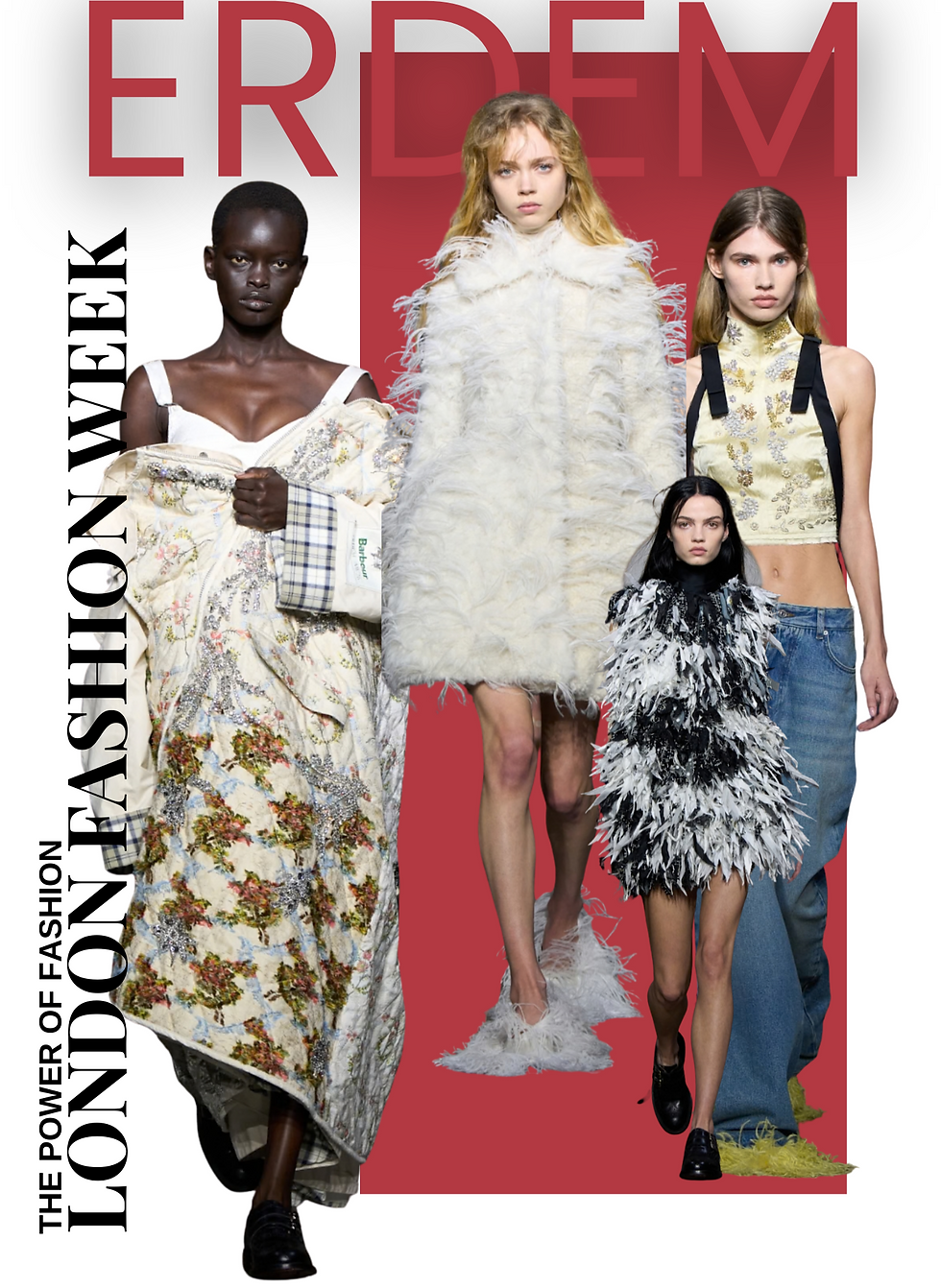
Erdem Moralıoğlu does not design for noise. He designs for memory.
The collection, titled The Imaginary Conversation, marked the twentieth anniversary of his house. It was not retrospective. It did not indulge in self-congratulation. Instead, it unfolded like correspondence — letters written across time between women who never met yet seemed destined to speak to one another.
Sometimes, to understand a designer’s story, one must see the entire arc of a collection — how one silhouette answers another, how colour rises and then recedes. But with Erdem, something rarer happens. Each garment carries its own narrative weight.

A coat does not simply cover; it remembers.A dress does not simply drape; it insists.
There were pannier silhouettes fractured and rebuilt. Opera coats collaged from remnants, as though history itself had been taken apart and reassembled with sharper intent. Tailoring appeared turned inside out, exposing construction, revealing process. Nothing was hidden. Nothing apologised.
He revisited women who have long inhabited his imagination — Maria Callas, Radclyffe Hall, Adele Astaire — not as costume references, but as intellectual companions. Writers leaned toward dancers. Actresses seemed to whisper to botanists. Outsiders interrupted icons. The tension was deliberate. These women did not agree. They did not resolve neatly. That was precisely the point.

There was also rebellion.
A bridal echo from 2006 returned — but fuller, louder, more assured. Not nostalgic, but evolved. A reminder that youth and maturity are not opposites; they are chapters in the same argument.
I had just returned from Paris Haute Couture, where grandeur is often expected and sometimes overperformed. Yet this show stood comfortably within that calibre. The craftsmanship was exacting. The silhouettes controlled. The drama earned, not manufactured.
And still — it remained in british soil.
This is what matters.
In an era where many brands seek validation abroad, Erdem has remained rooted here. London is not the easiest fashion capital. It can be chaotic, underfunded, impatient. But it rewards originality. It protects intellectualism. It allows designers to be peculiar, and serious, and romantic, all at once.

This was unquestionably one of the three strongest shows in London this season.
The audience reflected that loyalty. Keira Knightley, Helen Mirren, Glenn Close — women whose own careers have been built on depth rather than noise — sat in quiet attention. Anna Wintour observed with the composure of someone who understands endurance. After the show, there were embraces backstage. Not theatrical congratulations, but genuine ones.

I found myself seated beside Amelie Stanescu of @chez.amelie, a critic whose eye I like precisely because it is disciplined. There is comfort in sharing a runway moment with someone who sees beyond embellishment. We did not need to overanalyse. The clothes spoke clearly.
There were cocoon coats blooming with embroidered florals that felt almost defiant against the cold. Skeletal pannier dresses in lace that suggested fragility while asserting structure. Grain de poudre tailoring that curved the body into hourglass precision, then undid itself with tulle and bow.
Bows appeared again and again — delicate, almost girlish — yet placed with such certainty that they became emblems of control rather than decoration.
The palette shifted from black to ivory, from powder pink to riotous red, from archival blue to green fil coupé that caught the light like memory caught mid-sentence. Satin glowed. Feathers trembled. Tulle hovered.
It was not maximalism. It was accumulation.
The kind that comes only with time.
I met Erdem few months ago at the V&A. Our conversation was gentle, thoughtful. He is not theatrical in person. He is observant. Humble. Curious. The kind of designer who listens before he speaks, and who understands that legacy is not declared — it is built, stitch by stitch.
There is no desperation in him. No chase.
Perhaps that is why his work feels so assured.
Fashion can be trivial. It can also be literature rendered in cloth. On that windswept afternoon at Tate Britain, it felt closer to the latter.
Twenty years on, the conversation is not closing. It is deepening.
And London, despite the wind, seemed proud. Thank you for inviting me.


Comments